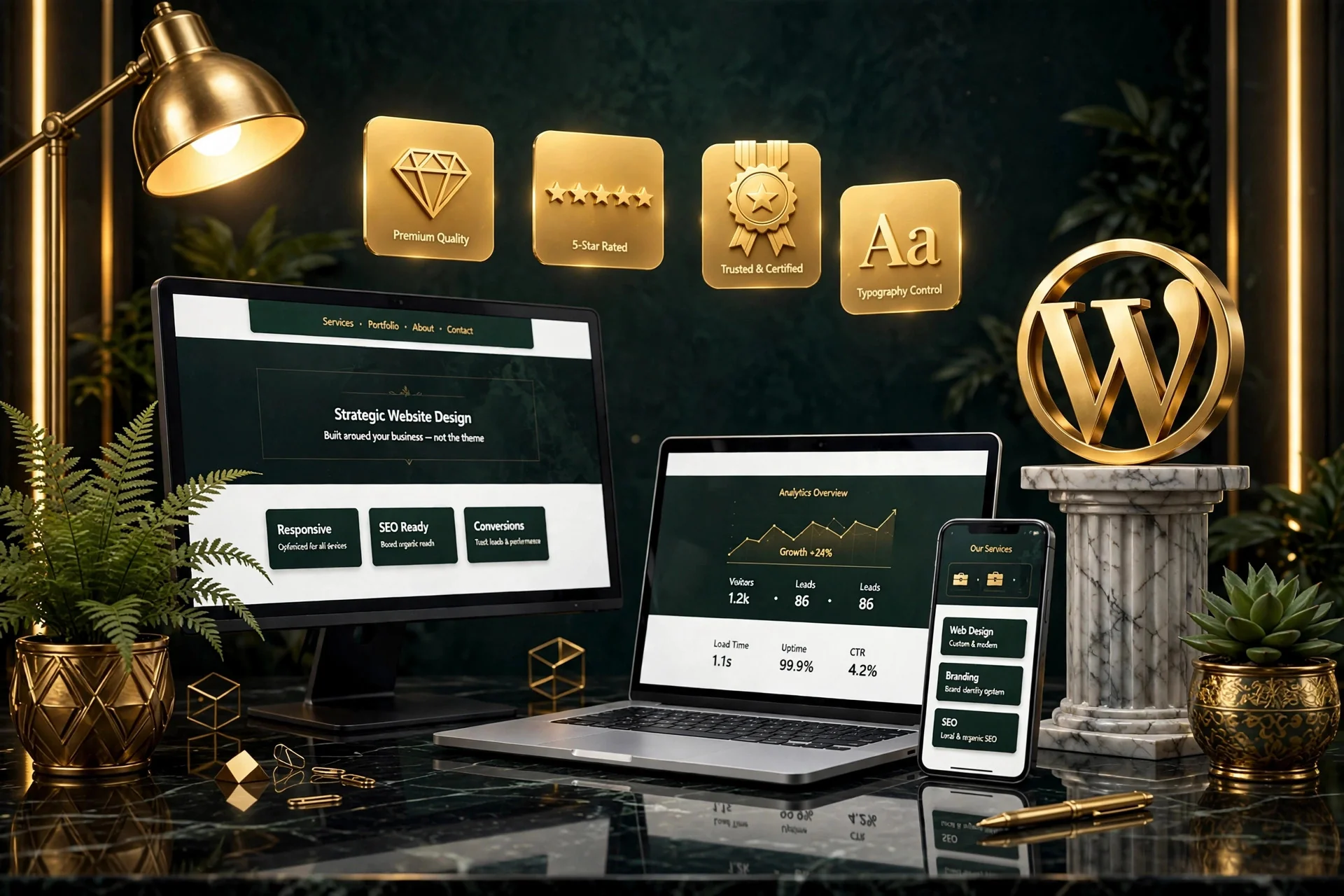
WordPress Website Design for Growing Businesses
I design and develop professional WordPress websites that are built around your business, customers, and growth goals—not just visual appearance.
Whether you are launching a new business, replacing an outdated website, or building a stronger online presence for an established company, I can help you create a WordPress website that is clear, responsive, manageable, search-friendly, and designed to turn visitors into inquiries or customers.
My work combines website strategy, UX, WordPress development, responsive design, technical quality, SEO foundations, and ongoing support so your website is built to remain useful after launch.
Osama Shamim
WordPress Website Developer & Consultant
Specializing in strategic website design, technical WordPress development, Core Web Vitals optimization, and long-term website management.
What Is Included in Professional WordPress Website Design?
Professional WordPress website design usually includes more than choosing a theme and arranging a few pages.
A complete website project involves website strategy, structural planning, user experience, custom development, performance considerations, and launch support.
Who Is WordPress Website Design Best For?
This service is designed for businesses that need more than a basic online brochure.
New Businesses
You are building your online presence from the beginning and need a professional website that gives the business credibility and establishes immediate trust.
Small & Growing Businesses
Your business needs a website that can support lead generation, content, SEO, and future growth without requiring a complete rebuild every single year.
Professional Service Providers
You need to communicate expertise clearly and convert website visitors into consultations, calls, bookings, or high-value inquiries.
Established Companies
Your current website no longer represents the quality of your company, but the best solution is a clean new build rather than minor patchwork edits.
Businesses That Need Ongoing Support
You do not want the relationship with your developer to end the day the website launches. If needed, I can continue managing, updating, securing, and improving the website after launch so you always have a trusted technical partner.
What Makes a Good Small-Business WordPress Website?
A good business website does not need unnecessary complexity. It needs to do the important things well.
It Explains the Business Quickly
A visitor should understand what you offer, who you help, why your business is different, and what they should do next. If users cannot understand those things quickly, even attractive design will struggle to perform.
It Is Easy to Navigate
Your website structure should reflect what visitors are looking for rather than internal company org charts. Important services, proof, and conversion pages should be easy to reach within 1-2 clicks.
It Works Properly on Mobile
A responsive website should not simply shrink desktop content. Layouts, typography, touch buttons, menus, forms, and important info must remain effortlessly usable on smaller screens.
It Loads Efficiently
Performance is considered during development. The website avoids bloated code, unnecessary plugins, oversized unoptimized media, and server bottlenecks that frustrate users and hurt rankings.
It Creates Trust
Professional design, clear messaging, genuine client reviews, documented case studies, direct contact details, and consistent branding all help visitors evaluate whether they should work with you.
It Has Clear Conversion Paths
Every important page helps the visitor take an appropriate next step: requesting a quote, booking a consultation, calling the business, submitting an inquiry, or exploring the next service.
It Can Grow With the Business
A good WordPress website remains manageable when you need to add new services, case studies, landing pages, resources, ecommerce functionality, or marketing campaigns.
Website Design Starts With the Business, Not the Theme
Before deciding how a website should look, I want to understand what it needs to accomplish. That usually means understanding:
- What your business offers and your core value proposition
- Who your ideal customers are and what problems they need solved
- Which services or products matter most to your profitability
- How customers currently find your company
- What key competitors are doing well or poorly
- What specific actions visitors should take on each page
- What functionality and integrations you need
- What role the website should play in future marketing and sales
Those answers influence everything from navigation to homepage structure. My goal is not to force your company into a pre-existing website layout. The website should be structured around the business.
What Can Be Included in Your WordPress Website Project?
Depending on the scope, your project can include the following comprehensive components.
Website Strategy
Determining core website objectives, user flows, and conversion paths before design begins.
Sitemap & Architecture
Organizing pages into a logical hierarchy for seamless navigation and search engine discovery.
Homepage Design
High-impact homepage that establishes authority, services, trust proof, and immediate calls to action.
Dedicated Service Pages
Standalone landing pages giving each core offering depth to rank on search and convert leads.
Responsive Mobile UX
Meticulously crafted layouts for smartphones, tablets, laptops, and ultra-wide screens.
Clean WordPress Code
Production WordPress development built for maintainability, security, and administrative ease.
Elementor Customization
Tailored framework configurations built around your brand rather than rigid generic templates.
Contact & Lead Forms
Custom inquiry forms capturing exactly what you need with automated owner notifications.
Conversion Architecture
Strategically placed CTAs guiding visitors smoothly toward consultations and sales.
Content Implementation
Styling and implementing approved copy, photography, case studies, and brand graphics.
Technical SEO Foundations
Clean URL hierarchy, heading structures, meta tags, schema markup, and crawlability.
Analytics & Launch QA
Google Analytics/tracking integration, cross-device QA testing, and zero-downtime launch.
My WordPress Website Design Process
A clear process reduces unnecessary revisions and helps keep the project aligned with the business goal.
1. Discovery
Business goals, customer profiles, competitors, functionality requirements, and existing site audit.
2. Website Planning
Defining required pages, information architecture, navigation paths, and feature integrations.
3. Content & Structure
Organizing page sections, service positioning, testimonials, FAQs, and calls to action.
4. Visual Design
Developing visual layouts, typography, and color schemes aligned with your brand identity.
5. WordPress Development
Building the approved design in WordPress with clean code and robust plugins.
6. Responsive Optimization
Fine-tuning layouts and touch interactions across smartphone, tablet, and desktop views.
7. Testing & Review
Thoroughly checking navigation, forms, links, page speed, and browser compatibility.
8. Safe Launch
Publishing the website with zero downtime and verifying domain, DNS, and SSL configurations.
9. Ongoing Improvement
Optional seamless transition into monthly WordPress maintenance and continuous growth.
How Long Does a Professional WordPress Website Take to Build?
A professional WordPress website can take anywhere from a few weeks to several months, depending on its size, content, functionality, feedback process, and complexity.
Small Business Website
Focused 5 to 10-page websites with clear scope, provided content, and standard lead-generation forms.
Larger Service Website
Extensive service deep-dives, custom case study hubs, resource libraries, and multi-step inquiry funnels.
WooCommerce & Custom Portals
Functionality-heavy projects requiring payment gateways, shipping rules, product imports, and APIs.
Key Factors That Influence Your Timeline
I prefer agreeing on a realistic project schedule after reviewing the scope rather than promising the same delivery time for every website.
How Much Should You Budget for a Professional WordPress Website?
The cost of a professional WordPress website depends on what the website needs to accomplish. A simple informational website and a conversion-focused website with custom layouts, many service pages, integrations, ecommerce, SEO requirements, and ongoing support are very different projects.
What Directly Influences Project Pricing?
Why Use WordPress for a Business Website?
WordPress remains a strong option for many businesses because it combines flexibility, content management, extensibility, and ownership.
Flexible Content Management
Businesses can manage pages, articles, images, and service updates without relying entirely on a developer for simple text changes.
Vast Global Ecosystem
WordPress supports limitless functionality through established themes, plugins, developer APIs, and modern page builders.
Ideal for Service Companies
Works exceptionally well for service pages, case study archives, resource blogs, lead forms, and ongoing content expansion.
WooCommerce Integration
Seamlessly add full ecommerce capability, payments, and product catalogs within the exact same website ecosystem.
Search-Engine Friendly
Provides a robust technical SEO foundation with clean URL structures, easy sitemap generation, and schema support.
Complete Digital Ownership
You own your codebase, database, and files completely. You are never trapped in a proprietary closed platform.
That said, WordPress is not automatically the best platform for every possible website. The platform should fit the project’s needs rather than being chosen only because it is familiar.
Should SEO Be Considered While Designing a Website?
Yes, absolutely.
SEO is much easier to address during the planning and development process than after a website has already been built around a weak structure. Important website design decisions directly influence search visibility:
For businesses that expect organic search to become an important acquisition channel, SEO should be part of the website conversation from the beginning. This avoids unnecessary technical and structural problems that make future SEO harder.
Can a New Website Be Built With AI Search Visibility in Mind?
Yes. Modern website planning considers not only traditional search engines but also how AI-powered search and answer systems (like ChatGPT, Perplexity, Google Gemini, and Copilot) understand businesses, services, expertise, and content.
Clear Business Entities
Structured data and contextual organization so LLMs accurately identify your business brand, leadership, and service specialties.
Dedicated Service Pages
Standalone topical depth allowing answer engines to extract specific, authoritative solutions for user prompts.
Answer-Focused Sections
Direct question-and-answer blocks directly addressing high-intent buyer inquiries for snippet extraction.
Structured Content & Schemas
Clean HTML semantic structure, tables, and Schema.org JSON-LD markup that machine algorithms can parse reliably.
First-Hand Proven Expertise
Author attribution, verified case studies, client reviews, and direct proof demonstrating authentic real-world experience.
Strong Internal Linking
Logical topical clusters that establish authority relationships between your core services and supporting articles.
Honest Perspective: No website design can guarantee AI citations, but the architecture can be engineered correctly from day one to give your business maximum visibility in AI retrieval results.
Can One Person Design, Develop, and Manage My WordPress Website?
Yes, when the project falls within that person’s areas of expertise.
I work across the entire WordPress website lifecycle, which means I can personally handle:
This gives clients the convenience of continuing with the same specialist after launch instead of immediately searching for another developer. For work outside my direct scope, I prefer being transparent rather than overpromising.
Do You Need a New Website or a Redesign?
The terms are often used interchangeably, but the right approach depends on what already exists and what should be protected.
Choose a New Website Build When:
- There is no existing website or online brand
- The current platform is proprietary or unsuitable (Wix, Squarespace, GoDaddy builder)
- The existing website has very little content or SEO equity worth preserving
- The business model, services, or structure needs to change completely
- You are building a substantially new commercial identity from the ground up
Consider a Website Redesign When:
- WordPress is already in place and hosting infrastructure is sound
- Valuable organic search traffic, keyword rankings, and backlinks exist
- Useful content, case studies, or custom functionality can be preserved
- The business primarily needs higher conversions, modern UX, and mobile polish
- Rebuilding from scratch would introduce unnecessary cost and SEO ranking risk
WordPress Website Design Examples
The most useful way to evaluate website work is to understand the problem behind the design. Each project represents a tailored business solution.
B2B Professional Consulting Practice
Challenge:
Outdated 6-year-old website was failing to generate qualified inbound corporate consultation inquiries, suffering from slow mobile speeds and unclear service descriptions.
Scope of Work:
Comprehensive website strategy, restructuring service architecture, modern custom Elementor layouts, consultation scheduler integration, and performance hardening.
Result: 45% increase in high-intent consultation requests within 90 days; mobile page load speed dropped from 4.8s to 1.1s.
Regional Healthcare & Wellness Clinic
Challenge:
Complex multi-practitioner services were overwhelming mobile visitors. High bounce rates and confusing contact flows led to lost prospective patients.
Scope of Work:
Mobile-first user journey redesign, streamlined appointment booking funnels, dedicated practitioner profiles, and technical on-page SEO foundations.
Result: Mobile conversion rate doubled; 60% reduction in abandoned booking inquiries; Core Web Vitals all green.
International Tech & Digital Agency
Challenge:
Needed to transition from a rigid custom template to a scalable WordPress platform capable of supporting rapid publishing, case studies, and lead generation.
Scope of Work:
Custom WordPress build with reusable modular blocks, dynamic portfolio showcases, advanced schema markup, and multi-language staging readiness.
Result: Over 200 keywords ranking on page 1 of Google within 4 months; marketing team gained full autonomy to publish landing pages.
Why Hire Osama Shamim for WordPress Website Design?
I am a WordPress website developer and website management specialist with more than seven years of professional experience across 350+ delivered projects.
WordPress-Focused Experience
WordPress has been my primary professional platform for 7+ years, giving you deep ecosystem mastery rather than generic multi-platform dabbling.
Design & Development Together
You work directly with one specialist who handles both UI/UX and production code—eliminating agency friction, delays, and miscommunication.
Business-Focused Decisions
Every page is built around who your customers are, what creates trust, and what actions drive revenue for your company.
Direct Long-Term Support
I don’t disappear when the site goes live. I offer continuous WordPress maintenance, updates, and on-demand development.
Broader Technical Mastery
Seamless support for WooCommerce ecommerce, Core Web Vitals optimization, technical SEO, and AEO/GEO answer architecture.
Independently Verified Feedback
Proven track record with 350+ verified 5-star client reviews on Fiverr, reflecting reliable international delivery.
What Happens After the Website Launches?
Launching the website is not the end of its lifecycle.
To stay fast, secure, and competitive, modern WordPress websites require continuous care after going live:
If you prefer not to manage those requirements yourself, I provide ongoing WordPress website maintenance and management. That gives you seamless continuity after the design project ends.
Frequently Asked Questions About WordPress Website Design
Clear answers to common questions about costs, timelines, responsive design, SEO, and the development process.
The price depends on the number of pages, design requirements, functionality, ecommerce, integrations, content, SEO requirements, and project complexity. I review each project before recommending a scope and price rather than charging every website the same amount.
Small-business website projects often take several weeks, while larger or more complex websites may take longer. Content readiness, project scope, integrations, feedback turnaround time, and revision requirements can all influence the schedule.
Useful materials include: business information, branding and logo files, service details, website copy, existing photography, testimonials, case studies, desired functionality, reference websites you admire, and access to your existing site or hosting where applicable. If some of these are not ready, we can identify and plan for what is missing during project discovery.
Yes. Website structure is a core part of the planning process. I help determine which core pages and dedicated service pages make sense based on your business model, customer journey, and website goals.
WordPress projects may use established themes, frameworks, Elementor, or other development tools where appropriate, but the website is always customized specifically around your business. I do not believe a company should be forced into an unrelated pre-built template simply because it is faster to deploy.
Yes. Responsive implementation is an essential part of professional website development. Important pages, navigation menus, forms, calls to action, typography, and interactive elements are optimized for desktop, tablet, and smartphone screens.
Yes. The website is built with technical and structural SEO fundamentals in mind, including clean permalinks, semantic heading tags, fast loading speeds, mobile usability, and XML sitemaps. A complete ongoing SEO campaign is a separate scope, but development decisions will never create unnecessary future search barriers.
Potentially, yes. The best migration approach depends on your current platform (Wix, Squarespace, Shopify, or custom), website size, content volume, functionality, URLs, and existing SEO authority. A migration is reviewed carefully with 301 redirects rather than treated as a blind copy-and-paste job.
Yes. If you already have WordPress, I assess whether the existing setup should be refreshed, redesigned, partially rebuilt, or replaced with a cleaner implementation while preserving your existing SEO value and high-ranking pages.
Yes. I work with WooCommerce for WordPress ecommerce projects. If ecommerce is a major part of the project, I review the store requirements separately because checkout, payment gateways, shipping rules, product variations, and third-party integrations significantly affect scope.
Yes. Ongoing WordPress website maintenance and management are core services I offer, providing safe updates, backups, security, performance checks, and on-demand content edits.
Performance is factored in during the build by minimizing plugin bloat, optimizing images, and writing clean layouts. Websites with severe legacy speed issues or complex hosting may also benefit from dedicated WordPress speed optimization.
Yes. I work remotely with businesses internationally, collaborating with clients across the United States, United Kingdom, Canada, Australia, Europe, the UAE, and other global markets via clear asynchronous and synchronous communication.
No. Website design provides a strong technical and structural SEO foundation, but organic rankings depend on many external factors including market competition, ongoing content creation, domain authority, backlinks, and search algorithm updates.
No. No legitimate provider can guarantee inclusion or citations from AI platforms. A website can, however, be structured with clear entity signals, schema markup, and question-and-answer architecture to improve how clearly search engines and AI systems discover and cite the business.
Send me information about your business, your existing website if you have one, required pages, functionality goals, and any problems you want the new website to solve. I will review the requirements and provide a clear, tailored recommendation and next steps.
Ready to Build a Website That Supports Your Business?
Your website should be more than a collection of attractive pages. It should help potential customers understand your business, trust your expertise, find the information they need, and take the next step.
If you need a professional WordPress website and want one specialist who can help with the strategy, development, launch, and ongoing support, tell me about your project.
Direct communication with Osama Shamim • Proposals and project scoping delivered within 24–48 hours